Clinician views lung airways on Ion screen

Why Robotic Bronchoscopy

Globally, someone is diagnosed with lung cancer every 13 seconds.
And every 17 seconds, someone dies from it.1

Helping address a leading cause of cancer mortality

Lung cancer is the leading cause of cancer-related deaths worldwide.2 In the U.S, the average five-year survival rate for all stages of non-small cell lung cancer (the most common kind) is only 30%,3 with detrimental impact: lung cancer accounts for more deaths than colorectal, breast, and prostate cancers combined.4 One reason for the low survivability is that about 64% of patients are diagnosed at a nonlocalized stage,5 meaning the lung cancer is detected after it has spread beyond the initial tumor. For these patients, time is critical.

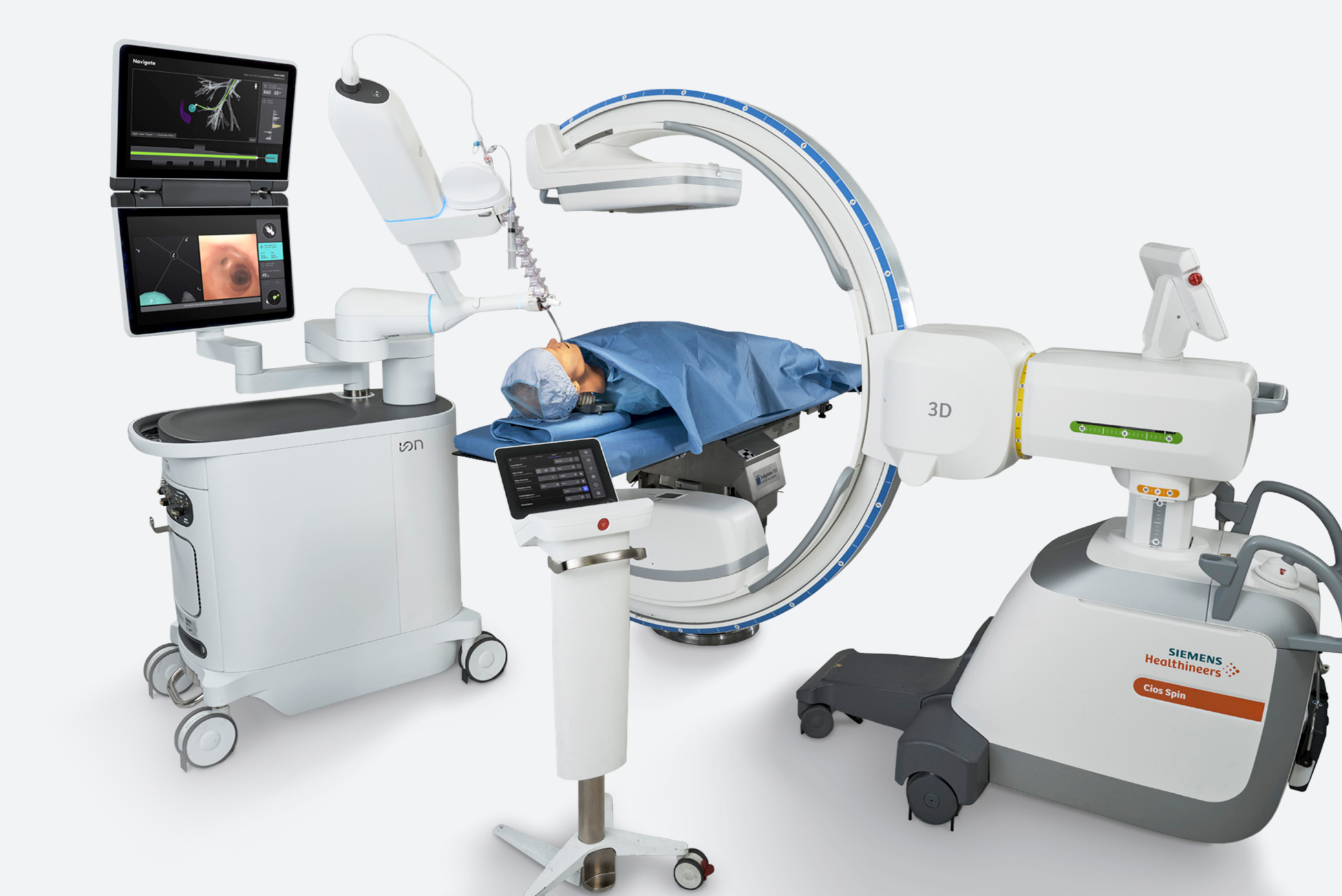
Ion system in a suite integrated with Cios Spin
Patient undergoing robotic bronchoscopy with Ion
Vison Probe

Contact us

Get in touch for additional information about Ion and to have your questions answered.

 
Form submission thank you

Thank you for your submission.

  1. World Health Organization: Global Lung Cancer Incidence in 2022. https://gco.iarc.who.int/today/en/dataviz/tables?mode=cancer&cancers=15&group_populations=1&multiple_populations=1 Accessed 31 March 2026.
  2. Bray, F., Laversanne, M., Sung, H., Ferlay, J., Siegel, R. L., Soerjomataram, I., & Jemal, A. (2024). Global cancer statistics 2022: GLOBOCAN estimates of incidence and mortality worldwide for 36 cancers in 185 countries. CA: a cancer journal for clinicians, 74(3), 229–263. https://doi.org/10.3322/caac.21834
  3. American Lung Association. State of Lung Cancer 2025 Report; https://www.lung.org/research/state-of-lung-cancer, accessed on March 31st, 2026.
  4. U.S. Cancer Statistics Working Group. U.S. Cancer Statistics Data Visualizations Tool. U.S. Department of Health and Human Services, Centers for Disease Control and Prevention and National Cancer Institute; https://www.cdc.gov/cancer/dataviz, released in June 2025.
  5. Stage at Diagnosis and 5-Year Survival Rate data for NSCLC published in State of Lung Cancer 2025. American Lung Association. Published November 2025. https://www.lung.org/research/state-of-lung-cancer, accessed March 31st, 2026.
  6. Horeweg N, van der Aalst CM, Thunnissen E, et al. Characteristics of lung cancers detected by computer tomography screening in the randomized NELSON trial. Am J Respir Crit Care Med. 2013;187(8):848-854. DOI:10.1164/rccm.201209-1651OC.
  7. R.J. Lentz, K. Frederick-Dyer, V. Planz, et al. Navigational Bronchoscopy Versus Computed Tomography-guided Transthoracic Needle Biopsy for the Diagnosis of Indeterminate Lung Nodules: Initial Results From the VERITAS Multicenter Randomized Trial [abstract]. Am J Respir Crit Care Med 2024;209:A6665. https://doi.org/10.1164/ajrccm-conference.2024.209.1_MeetingAbstracts.A6665
  8. Yu Lee-Mateus A, Resienauer J, Garcia-Saucedo JC, Abia-Trujillo D, Buckarma EH, Edell ES, et al. Robotic-assisted bronchoscopy versus CT-guided transthoracic biopsy for diagnosis of pulmonary nodules. Respirology. 2022. https://doi.org/10.1111/resp.1436
  9. Precision is the ability to place a biopsy tool in the desired location consistently.
  10. Results based on internal testing. Data on file at Intuitive.