Intuitive occupies a privileged position in medical technology and healthcare. We sit at the intersection of rapid innovation and such a deeply human purpose: improving how care is delivered, experienced, and accessed by patients.
I have spent my career in healthcare-joining Acuson in 1989 and moving to Intuitive in 1996 as a mechanical engineer responsible for designing aspects of our first robotic system that we hoped would have a profound impact on patient care. In those days, we had the privilege to be able to “scrub in” to cases to work shoulder-to-shoulder with physicians and care teams to better understand the hard problems they were working to solve. These were formative experiences, deeply cementing the fact that on the other side of all the late nights, product challenges, and engineering advancements, there was a patient who had put their trust in their physicians, and, by proxy, in Intuitive. In us.
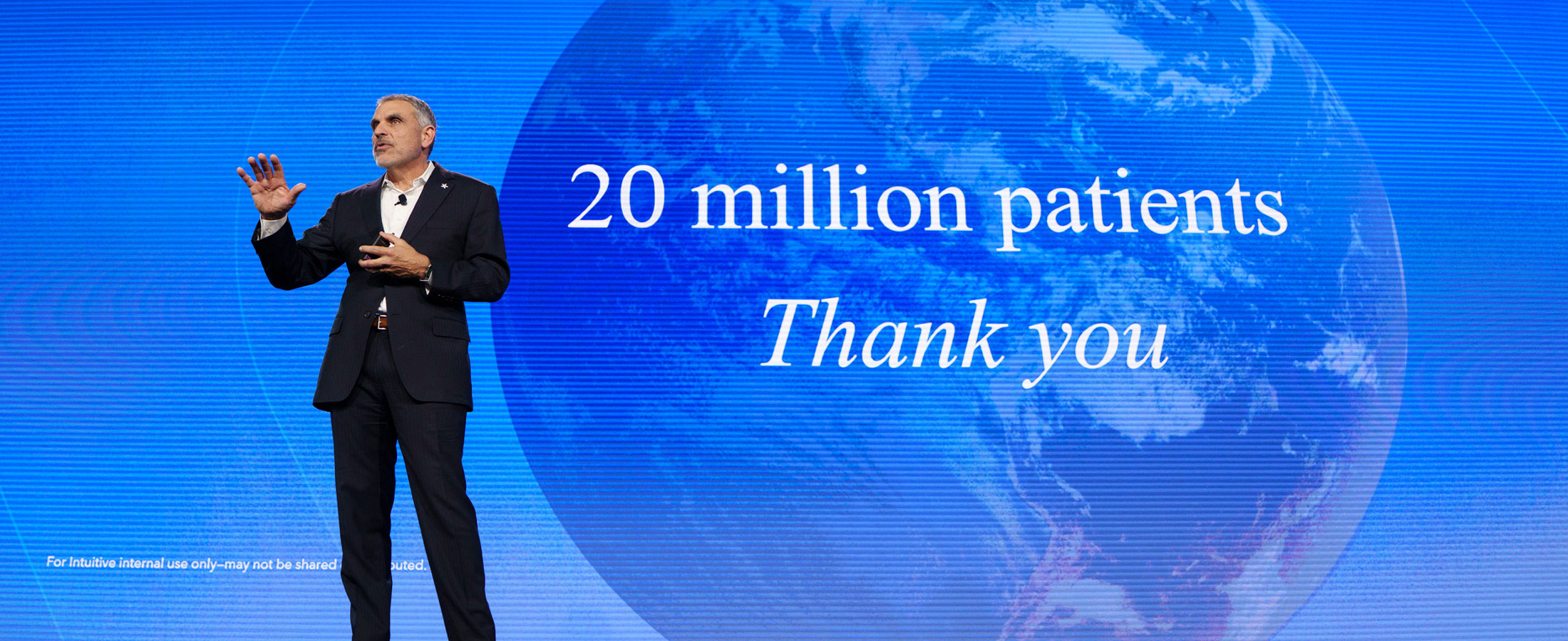
I’m often asked if any of us had envisioned the scale that surgical robotics would reach. The answer is unequivocally “no.” But fast forward 30 years and physicians have chosen Intuitive’s technology more than 20 million times to treat their patients, and this week, we marked 25 years as a public company, a step that enabled the company to invest in future innovation. These milestones aren’t a reflection of our passion for innovation; they echo our sustained focus and commitment to understanding what matters most to those delivering care.
Looking to the future, it’s clear that what progressed minimally invasive approaches this far will not be the same things that move it forward. The way we all think about healthcare and providing patient care is changing rapidly. Cancer diagnoses are increasing with an aging population, healthcare costs are rising around the world, AI is driving faster advancements in discovery, and patients are becoming super consumers of healthcare.
Our mission to deliver profoundly better care remains durable. However, we too must evolve while remaining focused on solving the real, pressing challenges in healthcare. Lung cancer offers a clear and urgent data point.According to the American Cancer Society, lung cancer has long been the leading cause of cancer death in the United States, and that’s not because it is untreatable, but because it is often detected too late. The problem we are working to solve is survivability — and that begins with reimagining the patient pathway from the moment they look for care.
When lung cancer is diagnosed early, at Stage 1a, five-year survival rates can exceed 90 percent. Yet today, Only 28 percent of cases are diagnosed at an early stage, and many patients wait more than six months between the detection of a suspicious nodule and treatment. During that time, patients can experience uncertainty, anxiety, and the very real risk of disease progression.
We can do better. By rethinking the full lung cancer journey — from detection to diagnosis, staging, and treatment — there is an opportunity to compress the 200-day pathway. And this is already happening.
New diagnostic technologies paired with real-time tissue assessments, endobronchial ultrasounds, and advanced robotic surgical systems can mean diagnosis and treatment of lung cancer in less than a month. That means innovation integrated with an ecosystem of skilled physicians and care teams can give patients more time. More time with answers. More time with their families. More time to do what matters most to them—cancer free. All by focusing on the hardest challenge: lung cancer survival.
Surgical and interventional innovation in healthcare is not defined by what is technically possible, but by what is responsibly delivered. It is measured in time saved in the OR, uncertainty and costs reduced, and outcomes improved for patients — and in whether care teams are better supported to deliver care when and where it is needed most. It is when these things come together that innovation can truly transform healthcare.
Important safety information
For important safety information, please refer to www.intuitive.com/safety. For a product’s intended use and/or indications for use, risks, full cautions, and warnings, please refer to the associated user manual(s).